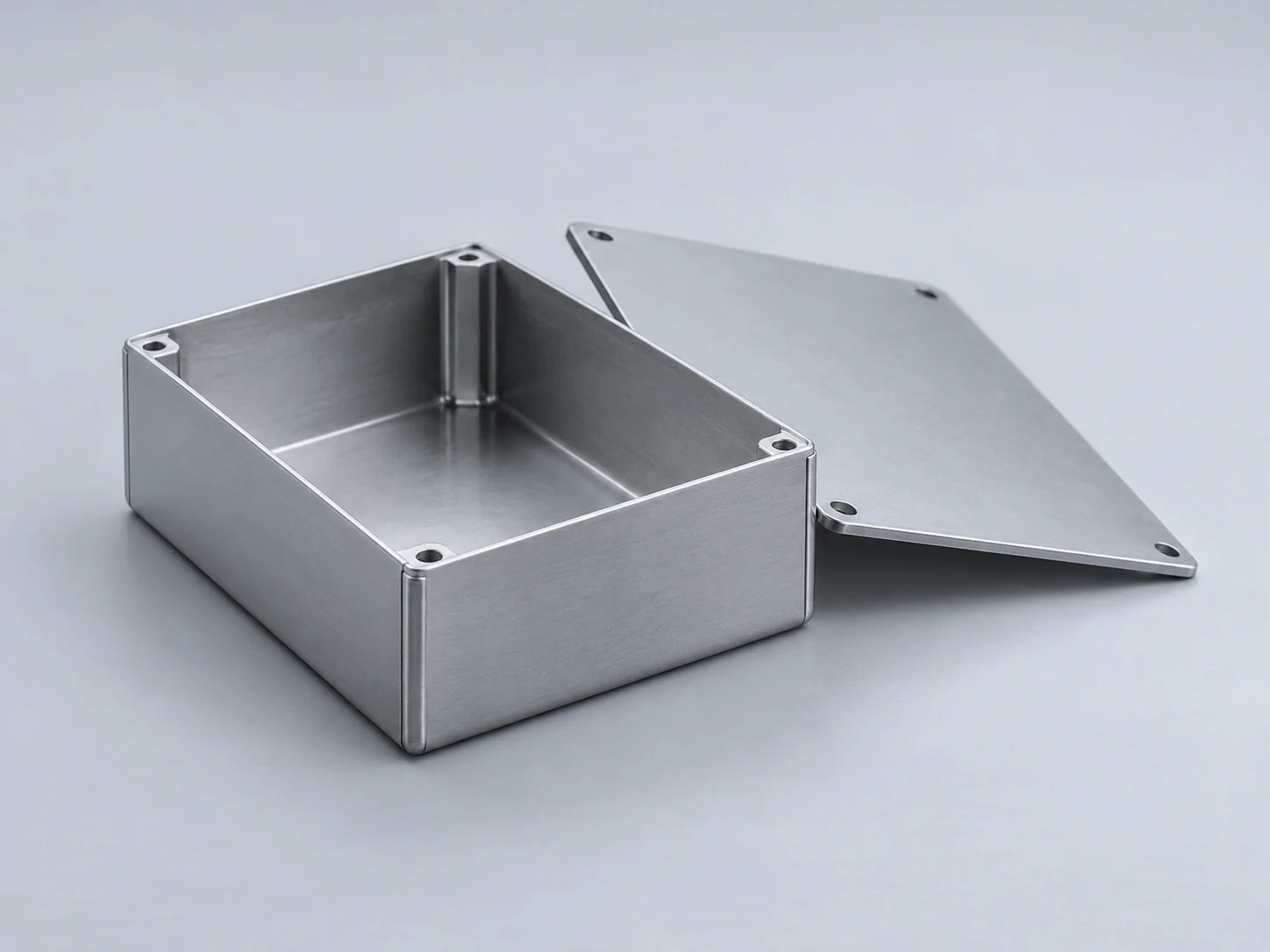
A custom enclosure is more than a folded box. The cover must close, the internal parts must fit, the fasteners must remain accessible and the finished surfaces must survive handling. These requirements are easier to review before a drawing becomes a purchase order.
Use the following checklist when sourcing sheet metal parts or a complete enclosure assembly. It is intended to improve the quotation package; the final dimensions and acceptance criteria belong on your approved drawing.
Define the assembled envelope first
Start with the space occupied by the complete assembly, including covers, hinges, feet, connectors and protruding fasteners. Give the supplier a clear indication of which dimensions describe the bare metal shell and which describe the finished product.
Mark the mounting faces and describe how the enclosure attaches to the larger machine or structure. If another team controls the mating component, include its interface drawing. Otherwise, two individually acceptable parts may still fail to assemble.
Review features close to bends
Holes and cutouts near a bend can change shape during forming. Protolabs discusses moving features, adjusting the design or producing certain features after forming, depending on the requirement. Its guidance also highlights flange length and available bend tooling. Use these as review topics; confirm the actual fabricator’s process limits for your part. Read the sheet metal design reference.
| Area to mark | Information to include | Approval question |
|---|---|---|
| Mounting holes | Location, size and datum reference | Does the finished part align with the mating assembly? |
| Bends and flanges | Formed geometry and controlled dimensions | Can the supplier form the sequence with suitable tooling? |
| Removable cover | Overlap, clearance and fixing method | Can the cover be installed and serviced as intended? |
| Visible faces | Appearance class and finish reference | What marks or variations are acceptable? |
Specify installed hardware with its location and sequence
Do not leave a threaded connection described only as “add M4 nut.” Identify the intended fastener type, hole requirements, installation side and relationship to adjacent bends. Ask the supplier to flag any conflict between forming, joining, finishing and fastener installation.
Where self-clinching hardware is proposed, the sheet material and thickness need to match the selected fastener’s installation requirements. PennEngineering’s guidance explains why panel hardness and preparation matter. The exact fastener catalogue controls the installation details. See the fastener installation reference.
Write a finish brief that the production team can use
Identify exterior and interior faces separately. Record any contact surfaces that must remain untreated, threads needing protection, visible weld areas and appearance samples to be used for approval. Specify the condition in which dimensions will be checked.
If the enclosure needs an ingress, electrical or other application rating, state the required test and acceptance route. A material choice or a powder-coated surface does not establish a rating for the completed enclosure. Include the covers, seals and hardware in the assembly review.
Approve a sample as an assembly
Before approval, install the intended internal components and use the actual mounting method. Check that service tools can reach the fasteners and that cables can be routed without interfering with covers. Record the sample revision and each requested change in one controlled list.
Agree the inspection record, protective packaging and shipment quantities before the production release. If a cosmetic surface needs individual protection, identify it explicitly. Packaging requirements can affect both quotation and the condition in which parts reach your assembly line.
Request an enclosure review with the current drawings, quantity, finish and assembly requirements. Our drawing preparation guide can help you organise the files.
Frequently asked questions
Should I provide a flat pattern or a formed model?
Provide the formed design and controlled drawing requirements. Include an existing flat pattern if available, but identify whether it is an approved manufacturing file or a reference. Agree who is responsible for the final unfolding and bend allowances.
Can holes be added after bending?
That may be an option when a feature needs to be controlled in the formed condition. Ask the supplier to compare the proposed sequence, tool access, cost and inspection method before approving it.
Does a powder-coated enclosure automatically have an IP rating?
No. An ingress-protection requirement concerns the complete enclosure and its test conditions. Define the required rating and testing with your engineering team, including covers, joints, seals, openings and installed components.
What should I check on the first enclosure sample?
Check the finished envelope, mounting interfaces, cover fit, fastener access, appearance and packaging. Trial-assemble the intended components and document any deviations against the exact drawing revision before releasing production.


